The SR-300 infrared integrating sphere is a non heat projecting precision optical instrument produced. The first integrating sphere was designed and built by Richard Ulbricht in 1894. The Ulbricht sphere was made in an effort to provide the best lighting coverage for the interior of train stations in Dresden, Germany.
Today the SR-300 m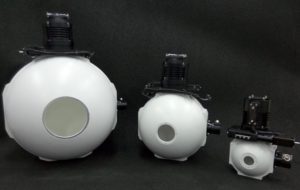
aintains its original function of maximizing reflection and minimizing the loss of the visible light spectrum by integrating a wide variety of light sources. Optional neutral density filters give even higher luminescence intensities from 1,000 ftL to 13,000 ftL and a wider dynamic range. When light from a halogen, LED or xenon lamp is projected into this sphere and against the
highly reflective coating on the inside, the integrating sphere produces ninety-eight percent uniform output at any of its four ports. It is an excellent tool for uniformity tests, detector response calibrations and noise equivalent radiance. An optional high resolution motorized attenuator may provide a continuous variable output. The SR-300’s spectral range varies from 0.44 to 2.2 microns.
The SR-300’s modular design easily interchanges between the visible light spectrum (VIS) and the short wave infrared spectrum (SWIR.) Though invisible to the human eye, short wave infrared light reacts in the same way as visible light, bouncing off objects to show their overall shape and placement. Short wave infrared light has shadows and contrasts similar to that of visible light. The visible light spectrum may be measured in microns with the cooler side that we often call ‘blue’ being 0.4 microns and the warmer or ‘deep red’ side being 0.7 microns. Integrating spheres like the SR-300, however, give off wavelengths of 0.9 to 1.7 microns, even when projected through glass. As a result, short wave infrared only appears to us in the final image as though it is a picture printed in grey scale.
Modern integrating spheres like the SR-300 offer a wide dynamic range of uses and relatively easy to use interfaces. They may be motorized or manually controlled. There are two different sizes as well. The eight inch (20 cm) sphere weighs about seven and one half pounds (3.5 kg) and the twelve inch (30.48 cm) sphere weighs about a little over twelve pounds (5.5 kg.) A smaller non standard version at four inches (10 cm) and about two and one half pounds (1 kg) is also manufactured. The line voltage needed for all of these spheres is 110/220 VAC and 50/60 Hz, meaning they may be used in almost any capacity.


